Multisensory Perception
How the brain combines uncertain signals during perception and action
Multisensory perception studies how people infer the state of the world from signals that are useful but imperfect. Vision, touch, audition, and proprioception each carry partial information, and the brain must decide when signals belong together, how reliable they are, and how they should influence perception and action.
The work spans cue integration, visual-haptic perception, body ownership, spatial perception, depth, material appearance, object shape, and crossmodal timing. It treats perception as a process of interpretation under uncertainty: sensory signals are noisy, sometimes ambiguous, and often affected by movement, context, prior experience, and recent adaptation.
This topic connects basic perceptual science with technology design. Understanding how multisensory signals are combined helps explain why delayed visual feedback can change perceived stiffness, why a virtual hand can feel more or less like one’s own, why synchrony matters for integration, and how XR and haptic systems can be made more intelligible by respecting perceptual constraints.
Key Questions
Related Keywords
Portfolio and Resources
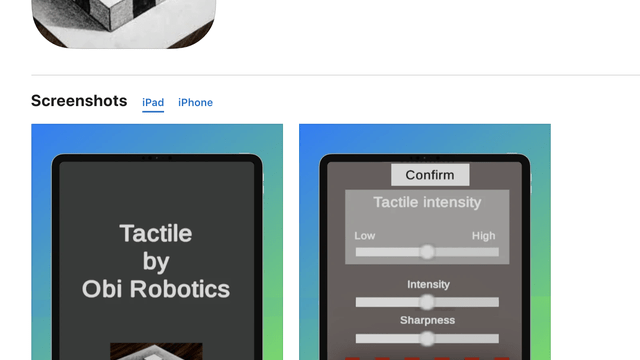 Tactile iPhone experiment
Mobile tactile perception experiment translating multisensory texture research into an accessible public app.
Tactile iPhone experiment
Mobile tactile perception experiment translating multisensory texture research into an accessible public app.
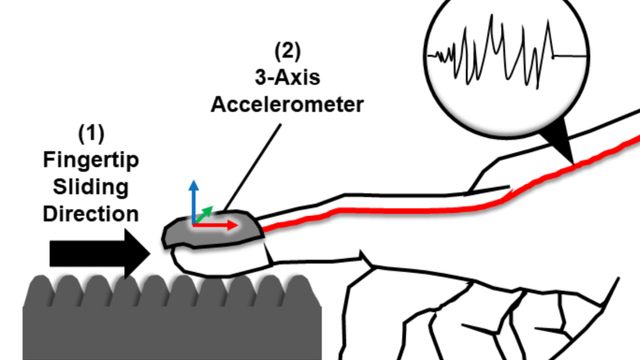 TactileMirror code
Code for a wearable sensory substitution device, supporting reproducible haptics and tactile augmentation research.
TactileMirror code
Code for a wearable sensory substitution device, supporting reproducible haptics and tactile augmentation research.
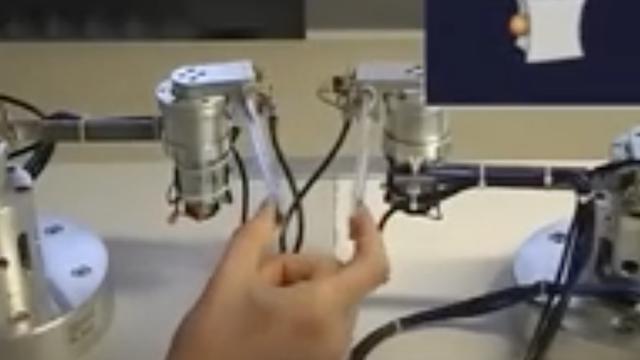 Simulation of a virtual stiffness
Archived demonstration of virtual stiffness and visual-haptic interaction.
Simulation of a virtual stiffness
Archived demonstration of virtual stiffness and visual-haptic interaction.
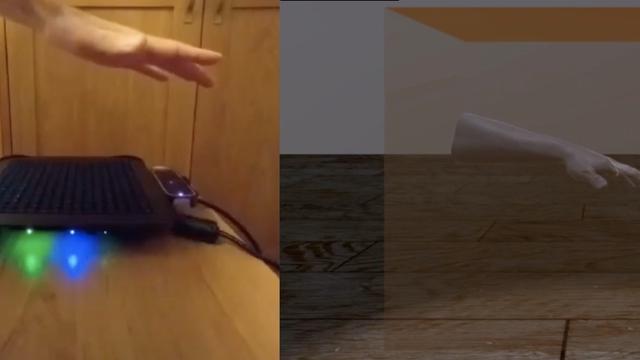 Ultrasound/visual virtual viscosity
Archived demo exploring perceived viscosity through combined ultrasound and visual stimulation.
Ultrasound/visual virtual viscosity
Archived demo exploring perceived viscosity through combined ultrasound and visual stimulation.
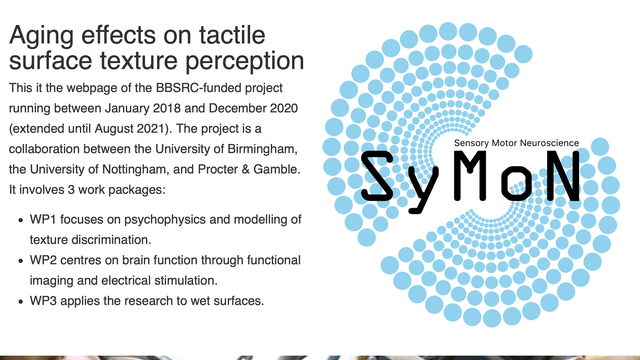 Aging Touch website
Public research resource on tactile perception, ageing, and surface texture perception, linked to BBSRC-supported work.
Aging Touch website
Public research resource on tactile perception, ageing, and surface texture perception, linked to BBSRC-supported work.
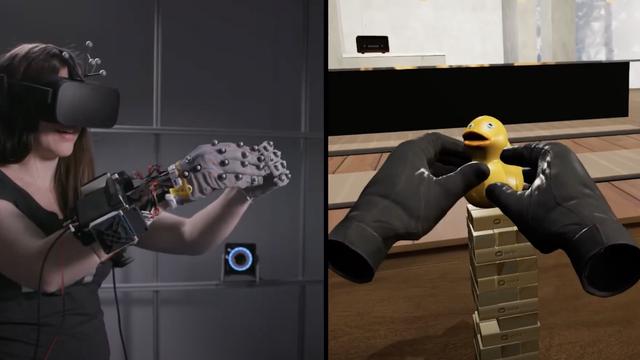 Oculus Connect haptic demo
Interactive haptic demonstration translating perceptual research into an industry-facing XR experience.
Oculus Connect haptic demo
Interactive haptic demonstration translating perceptual research into an industry-facing XR experience.